
Make it more specific
Writing tip: write your observations, not your evaluations

Ever struggle to make your sentences more specific?
I did, constantly.
Back then, writing with more specificity was difficult because I didn’t know how to flesh out specific details from general statements. I didn’t have a method. I’d write hundreds of words but didn’t know how to make them feel more alive, concrete, and stimulating.
It was frustrating.
Then, while reading a book about communicating compassionately (even in anger), I stumbled upon a concept that changed everything:
The concept of evaluation vs observation
Evaluations are our interpretations of what we observe.
Observations are things we see, hear, smell, taste, touch.
From the book:
“When we combine observation with [negative] evaluation, we decrease the likelihood that others will hear our intended message. Instead, they are apt to hear criticism and thus resist whatever we are saying.”
I think this applies to writing, too.
When we write our evaluation or judgment instead of what we observe, we decrease the likelihood that others will receive our intended message.
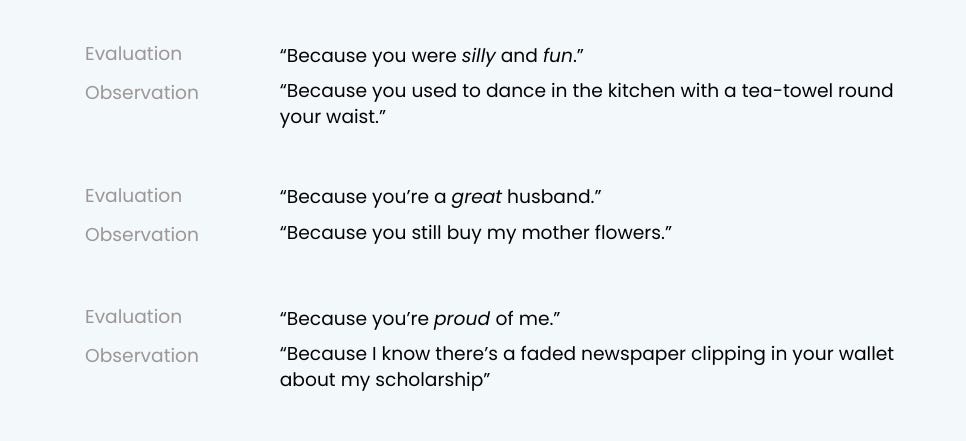
Take a look at the examples below.
Which stimulates your senses more? Which feels more alive?
“Writing great copy often boils down to illustration: how well can you show the prospect a moment in time? Because copywriting is all about moments, these small slices of life. And if you can impart these things in a way that generates a feeling, and then you connect that feeling to a product, this is how you compel people. This is how you sell things.”
- Eddie Shleyner, Very Good Copy
We may not always sell things with our words. But the goal of writing to communicate always stays the same: to let the reader experience the world through our lens.
Write your observations, not your evaluations
The next time you want to make your writing more specific, read your draft and mark parts where you’ve made a judgment or evaluation.
Then go through it again and ask yourself:
Why did I make that evaluation?
What objective fact—things I see, hear, smell, taste, touch—led to your conclusion?
A+ writers write with more specificity if needed.
Now you can, too.
Thanks for stopping by, and see you again.
Mark